JUZ History
The JUZ was opened in 1973 after the last youth center in Mannheim’s city center, DOMIZIL, had been closed in 1972.
As a result, young people no longer had any spaces where they could meet without pressure to consume. A new meeting place was needed—one free from supervision by social workers and control by the city, and one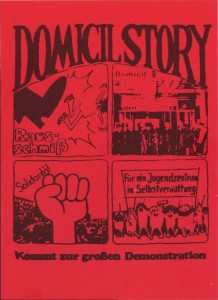 where people could freely express their creativity.
After long, difficult negotiations and repeated delaying tactics on the part of the city authorities, the JUZ was finally opened in 1973 in the former trade union building at O4, 8 in Mannheim’s city center.
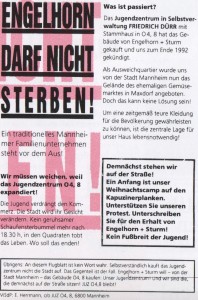
In the early 1990s, the City of Mannheim sold the building that had housed the JUZ for twenty years to the department store company Engelhorn & Sturm.
Where young people once organized themselves and became active outside the logic of capitalist profit-making, underwear is now sold in a prime downtown shopping location.
As a result, the JUZ was forced to move to a former garden center on the edge of the New Exhibition Square (Neuer Messplatz) in Mannheim’s Neckarstadt district.
However, the JUZ is not the only institution affected by the increasing commercialization of the city center. Rising rents have, for years, pushed people with lower incomes out of desirable neighborhoods and into peripheral areas, while city and state authorities heavily subsidize prestige projects such as the Pop Academy.
For this reason, the JUZ continues to see itself as a place where forms of social exclusion like these are critically examined and actively opposed.
The JUZ and Neckarstadt
In this sense, the JUZ fits well into Neckarstadt, a district where many people with limited financial means still live today.
Historically, this was also the case. Not far from the current JUZ, scattered between Lange Rötterstraße and Waldhofstraße, were Mannheim’s famous slums, known as the Spelzengärten, which existed until 1962.
During times of severe housing shortages, “informal” settlements made of wood, tar, and cardboard emerged there.
In 1931, 646 people lived in the Spelzengärten. They were described as “primitive earth and hut dwellings, hideouts, and defended possessions of precarious existences.”
The Nazis particularly despised the Spelzengärten because they were a center of communist activity and working-class resistance.
It was here that the resistance group led by Georg Lechleiter produced illegal leaflets and the underground newspaper Arbeiter-Zeitung (“Workers’ Newspaper”) until 1936.
The last remnants of the Spelzengärten disappeared in 1962 during the construction of the Herzogenried swimming pool and the development of the new exhibition grounds, next to which the JUZ is located today.

Want to learn more about the history of JUZ Friedrich Dürr?
This print publication is available directly from us.
